 Mia Zheng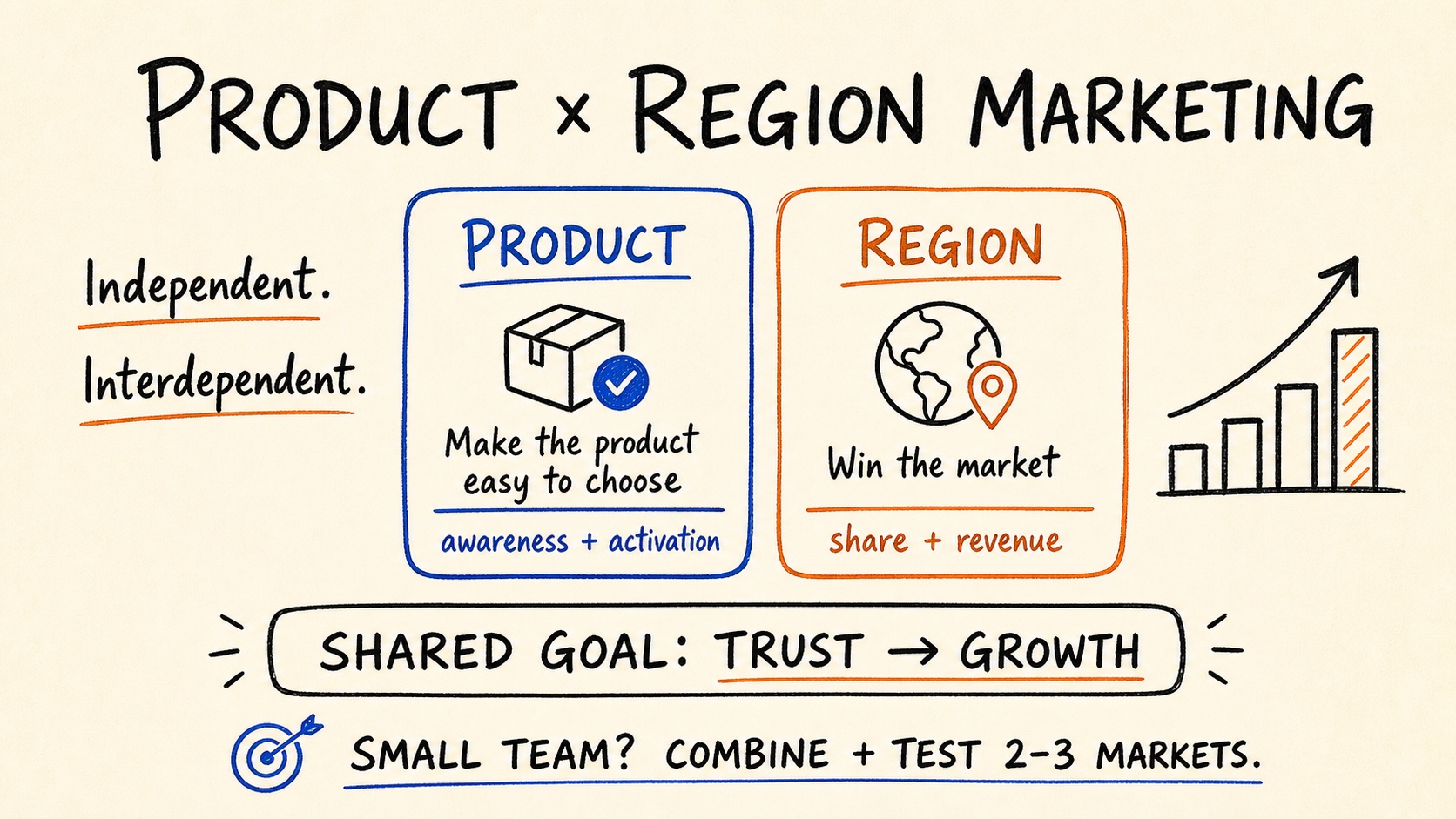
They take responsibility for different things, but they also depend on each other.
Focuses on market share and revenue contribution. Works closely with local resources — solution providers, agencies, and other partners.
Focuses on product awareness, user activation, and feature usage. Covers more areas and operates at a more macro level.
Region Marketing: share and revenue
Region Marketing focuses on market share and revenue contribution. Most of the time, you need to work closely with local resources — such as solution providers, agencies, and other partners.
Your job is not to keep telling them how great your product is. Your job is to show them what they can get by working with you: more revenue or higher gross margin.
What partners actually want
Already working with a better product. But I could offer higher commissions or a lower price.
A technical service provider, but lacked marketing capabilities. So we worked together to build a productized solution. 1 + 1 became greater than 2.
If neither of these approaches works, but you still want to expand in that local market, find a way to build a good personal relationship with their PIC. That's the reality.
The essence of cooperation is either shared interests or human relationships.
Product Marketing: awareness and activation
Product Marketing focuses on product awareness, user activation, and feature usage. Compared with Region Marketing, Product Marketing covers more areas and operates at a more macro level. But it is also one of the key reasons why partners or clients decide whether they can trust your product.
For a team trying to drive product-led growth, Product Marketing needs to do more.
The trade-off nobody escapes
There is always a trade-off between product development cost and the cost for clients to learn and use the product.
If you want to spend very little effort developing a product, that cost will likely move to the client. They will pay through learning time, operational effort, and a more complicated onboarding process.
If you want clients to understand and use your product with less friction, marketing needs to build more around the product. This includes product education, useful content, and an onboarding flow that is both simple and engaging.
If you are a small team
To summarize: if you are a small team, Region Marketing and Product Marketing can be combined. Start with 2–3 markets and create market-specific product promotion for each one.
Then you will find out which market has the higher ROI — or which audience is more willing to engage with you.
More like this?
I write about GTM, GEO, AI agents, and the messy middle of scaling a B2B product. New post every 2–3 days.
Read more posts →它们负责的事情不同,但也彼此依赖。
关注市场份额和收入贡献。大多数时候需要和本地资源紧密合作 —— 解决方案商、代理商,以及其他合作伙伴。
关注产品认知、用户激活和功能使用率。覆盖面更广,也更偏宏观。
Region Marketing:份额与收入
Region Marketing 关注的是市场份额和收入贡献。大多数时候,你需要和本地资源紧密合作 —— 比如解决方案商、代理商,以及其他合作伙伴。
你的工作不是不停地告诉他们你的产品有多好。你的工作是让他们看到,和你合作他们能得到什么:更多的收入,或者更高的毛利。
合作伙伴真正想要什么
本来已经在合作一个更好的产品。但我可以给出更高的佣金,或者更低的价格。
是一家技术服务商,但缺乏营销能力。于是我们一起做了一套产品化的解决方案。1 + 1 大于 2。
如果这两条路都走不通,但你还是想在那个本地市场扩张,那就想办法和对方的 PIC 建立好的个人关系。这就是现实。
合作的本质,要么是共同利益,要么是人际关系。
Product Marketing:认知与激活
Product Marketing 关注的是产品认知、用户激活和功能使用率。和 Region Marketing 相比,Product Marketing 覆盖的面更广,也更偏宏观。但它同样是合作伙伴或客户判断"能不能信任你的产品"的关键因素之一。
对于一个想要做 product-led growth 的团队来说,Product Marketing 需要做得更多。
绕不开的那个 trade-off
产品的研发成本,和客户学习、使用产品的成本之间,永远存在一个 trade-off。
如果你想在产品研发上花很少的力气,那这个成本很可能会转移到客户身上。他们会用学习时间、操作成本,以及一个更复杂的 onboarding 流程来买单。
如果你希望客户能以更小的阻力理解并用起来你的产品,那 marketing 就需要在产品周围搭建更多东西。这包括产品教育、有用的内容,以及一个既简单又有吸引力的 onboarding 流程。
如果你是一个小团队
总结一下:如果你是一个小团队,Region Marketing 和 Product Marketing 是可以合并的。先从 2–3 个市场开始,为每一个市场做针对性的产品推广。
然后你就会发现,哪个市场的 ROI 更高 —— 或者哪一类受众更愿意和你互动。